Showing posts with label Essays. Show all posts

Saturday, 10 April 2021

In Life And In Death, Prince Philip Embodied The Value Of The British Monarchy

The past few years have been turbulent for the British Royal Family. A slew of controversies, from the links between Prince Andrew and convicted sex offender Jeffrey Epstein, to the departure of Prince Harry and Meghan Markle and their subsequent accusations of experiencing racism within the 'Firm', have led to increased questioning among the young in particular about what the monarchy is for and why it exists in an age of democracy and representation. The death of Prince Philip yesterday, the man who dutifully stood two paces behind the Queen for over seventy years and did more than anyone to make the monarchs visible and accessible to the public, will plausibly only galvanise such questions once the mourning period has faded.

Though many monarchists may recoil at the question being asked at all, it serves an important purpose not only in testing the resilience of the nation's institutions, but the clarity of people's understanding of their usefulness. The Royal Family is not elected or directly accountable to its people, nor should it be, but it cannot persist unless the people feel proud to be represented by them and that the values they embody are the right ones. In this, the allegations surrounding Prince Andrew's close friendship with Jeffrey Epstein, and the Palace seemingly closing ranks to protect him, have been particularly corrosive. If the public is unsure why the monarchy remains important in spite of any controversies surrounding it, either the people in charge of maintaining our institutions, or the institutions themselves, are not doing their job. In this respect, while the death of Prince Philip, the Duke of Edinburgh, may be the first step in a period of transition for the monarchy, the remembrance of his remarkable life may also serve to remind the British people of its immense value to the nation and the world.

Friday, 2 April 2021

Uncertainty As The Path To Resurrection In Dante's Commedia

The Christian holidays have become largely divorced from their original meanings. In some ways this is helpful, allowing them to be days of universal celebration rather than exclusively serving a single section of our theologically diverse societies. Christmas is these days about giving, gratitude, and reuniting with loved ones, rather than specifically a celebration of Christ's birth. Christ's story encompasses those qualities, but what is celebrated are the shared values rather than the event itself. Though most are aware of Christmas' religious origins - it's right there in the name - the connection is not necessarily made between those origins and the values it now represents. This inevitably leads to the hackneyed complaint that Christmas is just about 'capitalism', which says more about the complainer's inability to understand the value of giving than they might have wished.

Easter is further divorced from the reasons for its Christian celebration than Christmas. In part, this is because the name does not tie in so obviously. According to the Venerable Bede, a seventh-century monk known as the 'Father of English history' for his ecumenical writings, the month of Christ's resurrection was called Eostremonath in Old English, named for the goddess Eostre. The association between the two stuck even after the name of the month changed. Aside from the loose symbolism of eggs to birth, the idea of resurrection has been lost in how we celebrate Easter today. In search of that original meaning and how it relates to our contemporary lives, we should look to one of the great works of the global literary canon, whose narrative not coincidentally begins on Maundy Thursday, just before Easter Weekend: Dante Alighieri's epic poem, the Commedia.

Sunday, 21 February 2021

Adam Curtis' Nostalgia For Radicalism Paints A Bleak Picture Of A World Changing For The Better

Adam Curtis released his latest documentary series, 'Can't Get You Out Of My Head', last week. All six episodes are currently available for UK viewers to watch on the BBC's iPlayer, while worldwide viewers can watch it here. As one might expect from Curtis, it is an expertly made visual collage with a superlative soundtrack, telling the stories of some fascinating figures largely forgotten to history, which Curtis ties together as part of his overall mission statement. This time, he is telling an 'emotional history' of how Western society embraced individualism to compensate for how the radicals of the past failed the change the world for the better, eventually leading to the rise of conspiracy theories and populism.

If that sounds familiar to Curtis' fans, it should: the documentary acts as something of a greatest hits of his previous concerns, ending up feeling almost as much of a retreat into Curtis' own history as that of the world. His signature phrases, '...And then something strange happened' and 'So they went back, into the passed' are trotted out in key moments much as how Marvel deploys beloved characters at unexpected moments for maximum fan excitement. It's as exciting, electric and eclectic as the best of his work to date. But then something strange happened: in going back, into his past, Curtis became infected with the very nostalgia-driven nihilism he attributed to others. In repeating his familiar refrains about our failures to improve the world, he missed how the world has been steadily improving in a different way to how he was expecting.

Monday, 25 January 2021

Do You Want To Build A Snowman? The Importance Of Small, Spontaneous Joys

It snowed in London yesterday, so I took the opportunity to walk to my local park. I stopped at one of my favourite spots, a small bridge overlooking a pond with a tree growing out of an islet in the middle and a small waterfall rippling in the background. The pond was partially frozen over and trails had been cut through the thin ice by ducks swimming to and fro from the shore. The bare branches of the tree were dusted with snow which was lightly shaken away whenever a bird landed or departed from them. At one point, geese flew overhead, migrating from the pond on the other side of the bridge for a change of scenery and to take advantage of an elderly woman throwing crumbs from a bag to the ducks in the water.

I've walked across that bridge countless time before, sometimes stopping to enjoy the moment before moving on, but rarely has the simple sense of life in and around it been so noticeable. I've written before about my walks around the park and my enjoyment of the small details which are so easily overlooked. This time, the half an hour I spent looking out across the little pond made me aware of how much the lockdowns of the past year have deprived so many of us of the experience of watching life innocuously unfold around us, whether in trails through an icy surface or snow displaced from a tree branch. It has also deprived us of the human contribution to that tapestry, the traces of our existence we leave behind not only as part of our own stories, but as additions to the stories of others. Specifically, in this case, a tiny snowman.

Sunday, 10 January 2021

Donald Trump's Twitter Ban Is A Justified Action Which Sets A Terrible Precedent

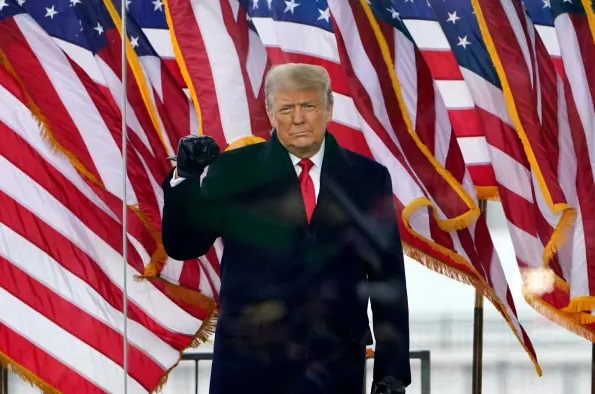
Donald Trump's incitement of an attack on the Capitol in Washington DC represented the tipping point for social media companies to do what it felt as though they had been equivocating over for a long time and banned the outgoing President of the United States from communicating on their platforms. That it has taken them so long to do so demonstrates the seriousness of the action taken: his missives have been marked and limited, but never fully banned until now.

Many will say that it was a long time coming and few outside the President's most ardent cadre would deny that he has used the platforms as a means of spreading misinformation in the most cynical, self-serving way. There are many reasons to deny Trump access to such platforms, especially after his (and Rudy Giuliani's) direct role in inciting a mob to storm the heart of American democracy. In the here and now, it is an understandable decision to take. In the bigger picture, it sets a potentially catastrophic precedent in allowing private companies free reign to decide which voices to permit or shut down based on nothing more than their subjective criteria.

Wednesday, 16 December 2020

On Her Majesty's Secret Service Is The Great Unrecognised Christmas Movie

UPDATE (23.04.21): For those interested, I've recorded a podcast with further discussion of Bond and OHMSS.

While online forum clever-than-thous are busy, yet again, trying to convince everyone that Die Hard is a Christmas movie rather than just a movie which happens to take place during Christmas, Bond fans have long rested merrily on the knowledge that the finest and most under-appreciated seasonal actioner of all rests within their favoured canon: On Her Majesty's Secret Service (1969).

It's worth acknowledging, however, that while OHMSS is a great Christmas movie, the best Bond movie to watch at Christmas is undoubtedly Octopussy, a perfect post-lunch confection big on stunts, scenery and silliness, where any ten minutes are sufficiently entertaining in their own right that you can drift off for half-an-hour of turkey-induced slumber only to reawaken and slot right back into the fun, barely encumbered by a plot which, let's be honest, nobody has ever paid the slightest bit of attention to anyway. That many wrongly think it's one of the worst Bonds due to the title alone makes it even more of a pleasant surprise. Nevertheless, while Octopussy fits the circumstances, it's On Her Majesty's which captures the spirit and themes of the yuletide season.

Wednesday, 9 December 2020

Emily In Paris' Gender Confusion Makes Brigitte Macron Look Un Peu Ridicule

I've been watching Emily In Paris! Only two months late, but it takes time to run out of literally anything else to watch on the internet. It's amusing enough in its cliché-drenched way and every bit as feather-light and disposable as Lilly Collins' entire filmography to date. The series can't seem to decide whether the eponymous Emily is a well-intentioned imbécile or a secret marketing genius à la Don Draper. Emily's ignorance-as-secret-genius makes its first major appearance in the second episode, 'Masculin/Féminin', in which our heroine realises that the French word for vagina, le vagin, is gendered masculin. This sets off her American outrage alarm and naturally, she solves this perceived injustice by posting about it on Instagram.

This brainless posturing from Emily is realistic enough as a sequence of events until the episode's final scene, where none other than Brigitte Macron posts her approval, sending Emily's post into the viral stratosphere. While the show's writers probably intended to depict Macron as trendy and au fait with American declarative activism, their ignorance about the origins and meaning of grammatical gender paint her, a former teacher, in a less than complimentary light.

Monday, 30 November 2020

William Blake & The Mythology Of Imagination

William Blake is best known to many through 'Songs of Innocence And Of Experience', his collection of poems taught in schools. In these poems, Blake contrasts two states of human existence: innocence, or the state of childhood, in which one sees the world with open eyes and an open mind, and experience, in which one's perception has been shaped and restricted by social forces and one's own inhibitions. The two states do not exist independently of each other and most of the poems in one book have a counterpart in the other, reflecting how innocence must grow to survive in the world of experience, and how only through experience do the best parts of innocence become valued.

These themes reflect concerns which echo throughout Blake's wider body of work in various forms. Blake was enraptured by interdependent dualisms, particularly the Biblical mythology which captured the imagination with stories of man's fall and rise, and organised religion's manipulation of those stories to maintain power and subjugate the masses both spiritually and sexually. Though sadly little known these days, Blake authored a prophetic mythology of his own, one of the great unrecognised works of the English literary canon, imagining how man could rise out of the subjugation of religion, education and rationalism and enter a state of pure imagination

Wednesday, 25 November 2020

Following The Science Is Scientifically Illiterate

'Science' has become the latest in a long line of words to have its fundamental meaning stripped away in aid of the dogmatic obsession with proving oneself 'right', or 'on the right side'. This latest act of liguistic repurposing was started by Extinction Rebellion, who have repeatedly claimed to be following the science while making demonstrably ludicrous statements such as suggesting that climate change will imminently cause billions of deaths, that deaths from weather-related disasters are on the increase, or that rising sea levels pose a threat to the existence of nations: all claims eviscerated by Andrew Neil last year in an interview with an Extinction Rebellion spokeswoman - who, to her credit, has since changed her mind and resigned.

The hypocrisy of making ludicrous, politically-motivated claims under the guise of science is, of course, nothing new for either political aisle. The left makes self-evidently ludicrous claims about imminent climate-caused human extinction, among others, just as readily as conspiracy theorists on the right try to pass off anti-vaccine myths (such as the MMR jab causing widespread autism in children) as 'scientifically' justified. What's telling is that the very idea of 'following the science' is itself profoundly unscientific.

Monday, 16 November 2020

Positive/Negative - Two Interpretations Of Freedom Which Divide The Political Left And Right

In 1958, philosopher Isaiah Berlin delivered to the University of Oxford a lecture entitled 'Two Concepts Of Liberty'. In this lecture, he laid out two competing interpretations of the concept of liberty. Negative liberty, most easily remembered as 'freedom from', is defined by the absence of obstacles to achieve your desires, short of those desires conflicting with the freedom of others. Positive liberty, most easily remembered as 'freedom to', is defined by the ability to act in such a way as to become the best version of yourself.

Though the distance between these definitions appears small, borderline intangible, in general terms, the nuances differentiating them is as clear an example as there has ever been of the difference in outlook between those on the right of politics and those on the left.

Friday, 30 October 2020

I Want Your Love & I Want Your Revenge: No More Heroes Game Analysis

In honour of the first two No More Heroes games being ported to the Nintendo Switch this week, it seemed as good a time as any to reissue an analysis I wrote up many years ago of a game series inspired by such diverse sources as Alejandro Jodorowsky's abstract Western El Topo and the Brit Punk music movement of the '80s, filtered through the lens of geek and video game culture. No More Heroes is a satirical and often surreal gaming extravaganza which I urge everyone who hasn't already taken a trip to the superbly named town of Santa Destroy to pick up as soon as possible.

Until developer Goichi Suda makes a concrete statements on the matter (which he won't – Japanese modesty prevents it), no-one can say for certain what ideas were suplexing around in that brain of his during the creation of the No More Heroes series. Everything from here on in is speculation, but hopefully speculation informed enough to offer a new perspective on the games and enhance your enjoyment. I will deal with the themes running through both games, so be warned that SPOILERS abound.
   

Monday, 5 October 2020

James Bond's COVID-19 Delay Suggests It Could Be Cinema's Time To Die

James Bond has pulled a Lionel Hutz. With cinemas struggling to get customers through their doors on account of the COVID-19 crisis, the theatrical exhibition industry's hopes of survival were resting on the promise of a new Bond film to get them through a potentially fatal winter. The name, No Time To Die, was almost symbolic: cinemas would survive and James Bond would get them through it. With the movie having already been delayed numerous times since its original release date was set for October 2019, the marketing campaign kicked off again with the release of a new trailer, soundtrack listing, partner promotions... only for another delay to be swiftly announced, this time to April 2021.

It seems that Bond's promise to cinemas was not 'No Time To Die', but 'No, Time To Die!'

Sunday, 16 August 2020

On WAP, Porn & The Marketing Of Women's Sexuality

Cardi B and Megan Thee Stallion's song, WAP, was released last week to predictable furore. The song, a loopy paean to female sexual arousal, divided listeners into the usual factions of the religious right outraged at the song's explicit lyrics and trashy aesthetic, and the left celebrating the song's sexuality as 'empowering' while being outraged at the outrage from the right. In short, another Groundhog Day of self-fulfilling internet shouting.

For all the fuss, 'WAP' doesn't offer much lyrically or aesthetically distinct from the long history of songs overtly about female sexuality. Christina Aguilera's 'Dirrty' released eighteen years ago and was more explicit and less comedic as a song and video. 'WAP' is firmly within the Nicki Minaj wheelhouse of playing its sexuality with pantomime humour. For my money, Minaj's 'Anaconda' is funnier and lyrically sharper: 'He toss my salad like his name Romaine' is a flat-out masterpiece of a line. For all the performed outrage on the left and right, 'WAP' is distinctly Widow Twankey in tone. That anyone could take such a deliberately silly song seriously enough to either get annoyed or celebrate its 'message' says more about the emptiness of the commenter's supposed values than the song itself.

Wednesday, 29 July 2020

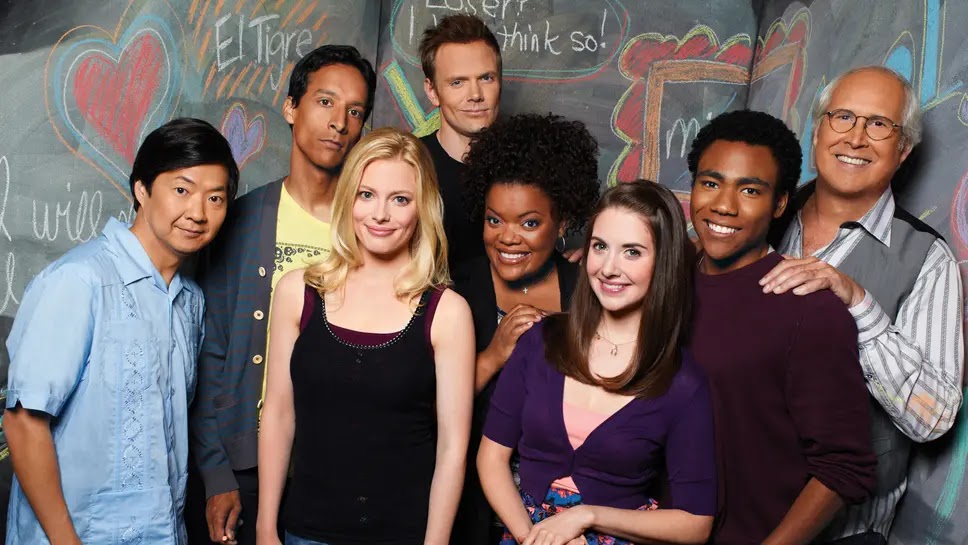
Community Shows How Political Correctness And Diversity Can Be Turned Into Great TV


As a consequence of the Black Lives Matter protests, the discussion over representation and diversity in pop culture has become especially heated in recent months. Episodes of beloved television shows, sometimes shows in their entirety, are being removed from streaming platforms for perceived infractions of the current code of heightened racial sensitivity. Characters in cartoons are being recast because the skin colour of the voice actor does not match that of the person they were portraying.

The invasiveness of these actions has been criticised, even from some who align themselves with Black Lives Matter, as another example of politically correct overreach. The result of this has been a poisoning of the well for any productive discussion of the issues involved. Instead of arguing over whether political correctness is a good or bad thing, perhaps a better question is whether it has ever been achieved in art in a widely accepted way, embodying the positive intentions from which the concept sprung rather than the authoritarian culture with which it has become interlinked. To that end, I present a show which is a prime example of how to turn a political correct ethos into great TV, albeit one which has regrettably had one of its most celebrated episodes scrubbed: Community.

Friday, 24 July 2020

Traditional Media And The Importance Of Unintended Knowledge


It's common to find online commentators celebrating the decline of traditional media, such as newspapers and magazines, over ideological bias and perceived entanglement in a corrupt political system. The idea that online media is free of those things is laughable, of course. The left and right alike have Youtube channels, blogs and online magazines catering to their political satisfaction, while both the current and previous Presidents of the United States, Barack Obama and Donald Trump, used online activism and media to great effect during their electoral campaigns. The online and printed media share many of the same faults, but with the key difference that printed media is governed by editorial standards where the online media is open to anyone and everyone, regardless of talent or intention.

For that reason alone, the slow demise of physical media is a sad thing indeed. For its myriad faults, our societies will only be less stable and more dogmatic should that demise come to pass. This article is not about editorial standards, though, important as they are. It's about an under-appreciated benefit of picking up a newspaper and magazine and reading it cover to cover: the acquisition of unintended knowledge.

Thursday, 16 July 2020

Looking Up


A lot of time in modern life is spent looking down. Looking at phones, looking at the floor to avoid eye contact in public, performing everyday tasks requiring concentration, when feeling bad about something or deep in thought over a difficult topic, even reading a book sometimes (crazy, I know). Despite this predilection for downward staring, it's interesting how the language we use tends to frown on it. To say something or someone is 'looking down' suggests poor prospects. Calling someone a 'navel gazer' has negative connotations even if the expression's dictionary meaning - to be contemplative and detail-focused - is simply describing a personality type.

By contrast, the phrase 'look up' is a highly positive one. It describes both positive prospects and admiration. One could argue that this is related to nothing more than a general view of 'up' as good and 'down' as bad - I wonder whether this is psychologically rooted in our oldest ancestors being tree-dwellers, where being 'up' would have been safe and 'down', whether on the ground or falling, unsafe - but the implication of shifting one's gaze suggests specificity. Having recently conducted a thoroughly scientific experiment on the topic by, uh, looking up, my feeling is that we've been trying to tell ourselves something: looking up is wonderful.

Wednesday, 1 July 2020

The Ideology Pandemic


There are two major world events happening right now which require opposing action from those involved to achieve their goals. The COVID-19 pandemic requires people to self-isolate and stay at home in order to prevent the virus from spreading. The Black Lives Matter protests demand people pack together on the streets in opposition to the continued existence of racism in Western societies.

Though the actions demanded by each event are in direct conflict with other, the spread of COVID-19 has highlighted how similarly viruses and ideologies propagate in our hyper-connected, politically polarised society. In Christopher Nolan's film, Inception, the protagonist, Cobb, is charged with entering a target's mind and implanting an idea in order to affect behavioural change in the real world. In order to make the idea stick, they dig deep into their target's subconscious for a point of personal vulnerability where, upon awakening, the target cannot dismiss the idea as a passing thought because it has been made intrinsic to his sense of self.

Tuesday, 9 June 2020

Vandalism, Violence And The Ethical Lines Of Protesting


Just as looting and arson have marred ongoing protests in the US by Black Lives Matter, following the killing by police of George Floyd, a similar story unfurled in anti-racism protests in the UK over the weekend. In London, 49 police officers were injured (numbers for protester injuries have not been forthcoming so far), including the hospitalisation of a policewoman after her horse was attacked, and a statue of Winston Churchill was defaced with accusations of racism less than a month after VE Day. In Bristol, a statue of the slave trader and city benefactor, Edward Colston, was pulled down and thrown in the River Avon.

As usual, reaction to the protests has been split down ideological lines. The right has condemned the violence, with UK Home Secretary, Priti Patel, describing the vandals as 'thugs' who would 'face justice'. The Prime Minister, Boris Johnson, directly condemned the tearing down of the Colston statue as a criminal act. The left has been more equivocal, with the Guardian focusing on the protest's anti-racist message and largely ignoring the defacement of the Churchill statue in their extensive reporting. Meanwhile, the BBC has been criticised for downplaying the violence and cropping a protestor wielding a weapon out of photos. Whatever one's stance on the issue, an important question remains unanswered: is there a point at which violence and vandalism become ethically acceptable?

Friday, 15 May 2020

Does Beauty Have Moral Value?


The COVID-19 pandemic has issued a long-overdue battering to the unhealthy dogma of the body positivity movement, which, like all movements adopted by political activism, began with a valid premise (no individual deserves to be abused by another for how they look) and mutated into something dangerous (obesity is good and risk-free). It goes without saying that abusing people for being fat is unacceptable, but denying that being overweight comes with serious health complications is no better than promoting anorexia as a harmless way to live.

One of the body positivity movement's bugbears is the 'beauty standards' by which societies supposedly define what is considered attractive and what is not. Although used disingenuously by the movement - beauty standards can be basically summarised as aligning with whatever best represents good health and prosperity in that time and place - it raises a more interesting question of the significance and role assigned to beauty in our society and whether it goes beyond simple aesthetics and into having actual moral value.

Thursday, 30 April 2020

When Hypocrisy Is Necessary In Politics And The Law


A Twitter spat flared up last night over comments made by a  conservative US commentator, Ben Shapiro, in a clip from an interview with Dave Rubin. The comments in question centred around Shapiro raising the point that when it comes to assessing the impact and response of the COVID-19 pandemic, there is a difference between the death of a young person and an elderly one.

I haven't seen the entire interview, nor do I plan to - neither Rubin nor Shapiro are commentators I am a fan of - so will confine myself to the short clip and not address any wider points Shapiro might have been making. Although Twitter predictably reacted as though Shapiro had suggested the elderly be abandoned to die, his point was that when deciding how much of the economy and people's long-term quality-of-life to sacrifice in preventing COVID-19 deaths, age has to be part of the calculation. His point is adjacent to arguments I made in an article from earlier this month weighing up the costs of sacrificing our freedom and the economy against the need to keep people safe, albeit focusing on age rather than personal liberty. This is an issue which can be debated ad nauseam, but the topic made me think of another issue glanced upon in my aforementioned article, about the occasional necessity of hypocrisy in stating a principle against applying it.